International experts speak of the need for peaceful settlement of Nagorno-Karabakh conflict
Print
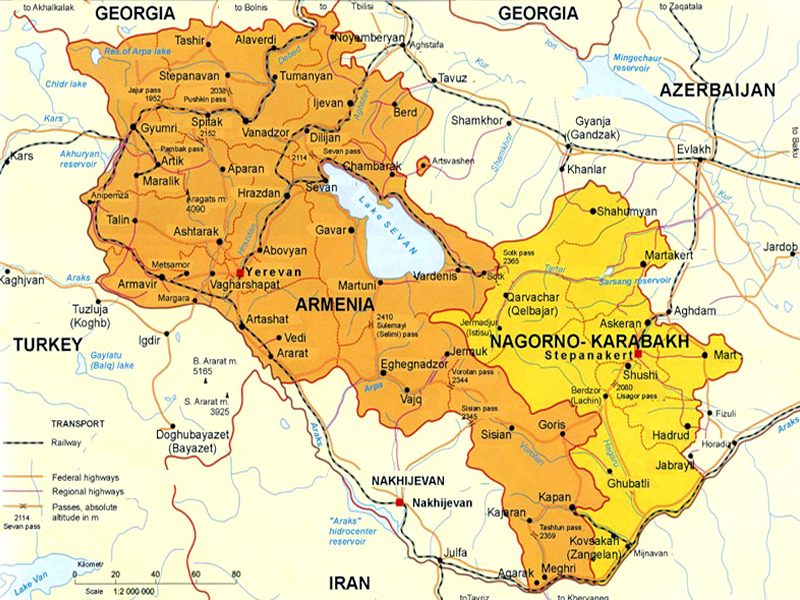
17 April 2012. PenzaNews. The negotiations over the situation around Nagorno-Karabakh Republic (NKR) have been going on for two decades. Now some experts consider it to be a “frozen conflict” but it still remains the deepest and most explosive in the entire post-Soviet space.

© PenzaNewsBuy the photo
Azerbaijan insists on preserving its territorial integrity and inviolability of the country’s internationally recognized borders. Armenia, in turn, defends people’s right to self-determination, protecting the interests of the unrecognized Republic of Nagorno-Karabakh, as it does not take part in the negotiations. Authorities of the two countries are alternately accusing each other of thwarting plans for peaceful settlement of the conflict, armed attacks on the contact line and reluctance to follow Madrid principles proposed by the OSCE Minsk Group.
Tigran Balayan, a spokesman for the Ministry of Foreign Affairs of the Republic of Armenia in his interview with news agency PenzaNews stated that the Azerbaijani policy prevents the stabilization of the situation in the region.
“Azerbaijan rejects and violates the non-use of force and threat of force principles, propagandizes xenophobia and anti-Armenian sentiment at the national level and does not comply with the provisions of resolutions adopted by the UN Security Council in 1993 provoking an arms race and provocations on the contact line. The country’s authorities refuse to withdraw their occupation troops from the territory of Nagorno-Karabakh, thus hindering the negotiation process,” Tigran Balayan said.
According to his words, the Madrid principles are “the fruit of joint efforts and they were eleborated at many summits at the presidential and ministerial levels.”
Tigran Balayan added that constant suggestions of Azerbaijan to change the agreed text are disrespectful to the partners and mediators — co-chairs of the Minsk Group.
“The principles’ cornerstone is the item which suggests that the final status of the unrecognized republic should be defined through legally binding will expression of Nagorno-Karabakh people. The sooner Azerbaijani leaders accept this, the sooner we have an opportunity to establish an atmosphere of peace and cooperation in the region,” the spokesman said.
At the same time Tigran Balayan noted that the position on this issue of Armenia and the OSCE Minsk Group coincide.
“Armenia has adopted principles proposed by France, Russia and the U.S. and is ready to move towards resolving the conflict adhering to these principles. Unfortunately, the statements and actions of Azerbaijan do not help and even hinder the solution of the problem,” he said.
Ilgar Velizade, a political analyst, deputy chief of the filial branch of RIA “Novosti” in Azerbaijan Republic, chief of the International Press-Centre “Novosti” in Baku, in contrast, believes that Armenia does not want to adhere to guidelines on the Nagorno-Karabakh conflict settlement.
“In general Azerbaijan consented to the implementation of the Madrid principles but Yerevan, in fact, ignored them having said that it was not going to discuss the independence of Nagorno-Karabakh. Armenian position is unacceptable for Baku and makes its participation in negotiations insensible,” he said.
According to the political analyst, Armenia believes that “time is on its side” because in international practice there are many cases of unilateral recognition of certain breakaway autonomies, such as Kosovo, Abkhazia and South Ossetia.
“However, they leave out of account the fact that territorial integrity of Azerbaijan is recognized by all countries but the independence of Nagorno-Karabakh is unlikely to be recognized. In addition, two Armenian states is too much for the small South Caucasus and it is not in the interest of any country in the region,” Ilgar Velizade said.
The expert expressed the hope that the governments would find strength to solve this problem for the sake of their own citizens. Nevertheless, along with peacekeeping efforts Azerbaijan, according to him, does not exclude violent conflict resolution spending so much energy and resources to strengthen its military capabilities.
Ilgar Velizade added that, according to Armenian Statistics Service, Armenian population is steadily declining: it is now close to 2.5 million people.
“Ten years ago there were over 3 million people in the country. People vote with their feet. And it is unresolved Karabakh conflict to blame. The population of Azerbaijan is now more than 9 million and it is growing. This is a good sign,” he stated.
According to the analyst, third parties’ interests in the region make the situation even more complicated and adversely affect the stability of the situation in the South Caucasus and Central Asia. Speaking about the potential war in Iran, the expert pointed out the possible refugees problem in Azerbaijan.
“There are 25 million Azeris in the Islamic republic. If we assume that even a few hundred thousand of them cross the Azerbaijani-Iranian border, social and military-political situation in our region will deteriorate, and this will have negative impact on resolving the Karabakh conflict,” the analyst said.
However, the possible attack of Iran, in his opinion, is unlikely to cause deterioration of the situation in Nagorno-Karabakh, because according to him, neither Armenia nor Azerbaijan are interested in the spread of Iranian conflict to the Nagorno-Karabakh region.
At the same time, Anatoly Tsyganok, the director for the Center of Military Forecasting at the Moscow Institute of Political and Military Analysis called Azerbaijan “the first Muslim country which initiated military-technical relations with Israel.”
“As far as I know, there is agreement between Azerbaijan and Israel which, in case of attack, gives Israel the opportunity to land its planes for refueling at the airfields of the Transcaucasian republic. In addition, Israel buys Azerbaijani oil and supplies arms to Azerbaijan,” the expert said, pointing out friendly relations between the two countries.
Anatoly Tsyganok also reminded that the next presidential elections in unrecognized Republic of Nagorno-Karabakh would be held on 19 July 2012.
“Whatever they say, the elections are held. No matter how they are evaluated — they are held. I would not call the NKR the state with the wrong policy. As far as I know, the current head of the state is nominated for the presidency of the republic for the second time and I admit that he can be elected again,” the analyst said.
However, the director for the Center of Military Forecasting does not anticipate resolving the Nagorno-Karabakh problem in the near future.
“The fact is that dialogue between the presidents of Azerbaijan and Armenia in the presence of Russian president has no legal force. President of the Nagorno-Karabakh Republic must be present at these negotiations,” Anatoly Tsyganok said.
His opinion is shared by well-known political scientist, the executive director of the International Centre for Human Development in Yerevan Tevan Poghosyan who also sees no prerequisites for speedy settlement of the conflict because of “one-legged format” of ongoing negotiations.
“First we need to rectify an error — the unrecognized republic should return to the negotiating table. I think that after this step, it will be possible to solve the pressing problems. The experience of ceasefire agreement between the conflicting parties suggests the need for such an approach,” the expert said.
Meanwhile, the analyst considers the political situation in the region very tense, and according to him, this is caused by a set of specific factors.
“Pre-election period begins in all countries involved in the conflict, including the Nagorno-Karabakh Republic. This means that more attention will be paid to the internal arrangement of these countries, the issues that directly affect the voters. In addition, there are other conflicts and unresolved issues in the South Caucasus, such as the Iranian nuclear problem, the Armenian-Turkish relations, other unrecognized or partially recognized states,” he said.
Tevan Poghosyan suggested that constant statements that this conflict has no military solution made by the OSCE Minsk Group co-chairs and senior representatives of such organizations like the UN and the OSCE “should cool Azerbaijan.”
“Finally, Baku must understand that war will not solve the problem but only aggravate the situation,” the analyst said, stressing the need for a peaceful settlement of the conflict.
In turn, Zulfali Ibragimov, an expert at committee on defense and security of the National Assembly of Azerbaijan, an assistant professor of political science at the Baku State University does not exclude that, resolving the conflict, Azerbaijan will have to use military force.
“Today, Azerbaijan is developing very actively, we strengthen our defense capabilities, and if we can not resolve the issue peacefully, we might have to use military force — it is our land. And no international organization, no country can not force us to release our territory,” he said.
However, he stressed that Baku supports peaceful settlement of the conflict and is ready to military action only if diplomatic measures are ineffective.
Uwe Halbach, a senior research fellow at German Foundation for “Science and Politics” believes that both Azerbaijan and Armenia should adhere to the peaceful ways of problem resolving.
“The situation is still unstable. I think now this label of frozen conflict is coming to question because we cannot exclude that there will be new military escalation around this conflict. But the peaceful settlement is possible though it is not visible,” the political analyst said.
Expressing concern over growing military potential of Azerbaijan, the European expert pointed out the need to continue the mediating process though it was not successful later.
“The mediating process has to be kept alive as it is the good instrument against war and we should also pay great attention to militarization in the region. Azerbaijan is one of the most military powerful countries at all post-Soviet space. From the beginning of presidential rule of Ilham Aliyev until now military spending was increased from 160–180 million dollars up to more than 3 billion dollars,” the analyst said.
Nicu Popescu, a senior fellow at the European Council for Foreign Relations and a former advisor to the Moldovan prime minister, also believes that there is very fragile stability in the South Caucasus.
“The prospects are still unclear because, on the one hand, the governments of the Transcaucasian countries talk about the need to take some actions but, on the other hand, neither Azerbaijan nor Armenia come close to a common denominator on the issue of Nagorno-Karabakh,” the political analyst said.
The expert reminded that the theoretical parameters of regional problems resolving had been discussed for a long time, but according to him, the modern political situation does not make Armenia or Azerbaijan address this issue.
“I do not think that one of the parties will change their position on the Nagorno-Karabakh conflict in the near future. And the current approach of both states leads nowhere,” said Nicu Popescu.
His opinion is shared by Guido de Graaf Bierbrauwer, a program coordinator for the South Caucasus at IKV Pax Christy organization.
“The public debate on both sides is so strongly against the others that at the moment any peace proposal would not be acceptable for the broader population. One of the key things for a peaceful settlement to be possible is to recognize and accept that certain compromises have to be made,” he noted.
According to his point of view, cooperation between civil society organizations from both sides to break the deadlock is enormously important. One of the main areas of work that needs much more focus is to counter the mutual hate amongst the broader population of Armenia and Azerbaijan.
The Nagorno-Karabakh Republic (NKR) was proclaimed on 2 September 1991. On 10 December 1991 the referendum about the status of NKR was held, where 99,89% of the participants supported its independence but results were not recognized by the international community. On 6 January 1992 the parliament of NKR of the first convocation accepted the Declaration “About the state independence of the Nagorno-Karabakh Republic.”
In 1991–1994 military conflict between NKR and Azerbaijan took place during which Azerbaijani forced Armenians out of the territory of the former Shaumjanovsky district of the Azerbaijan Soviet Socialist Republic and out of some Nagorno-Karabakh territories.
The country remains unrecognized by Armenia which considers Nagorno-Karabakh as a part of its territory. The country remains unrecognized by all the UN-member states as well. Resolutions of the UN Security Council and General Assembly of the United Nations confirm territorial integrity of Azerbaijan.