Possible extension of Manas lease agreement raises concerns in Kyrgyzstan
Print
22 March 2012. PenzaNews. The current U.S. lease agreement for using the Manas Transit Center at the international Airport Manas in Kyrgyzstan expires in 2014. However, the U.S. government continues to take interest in further use of the transit center. The other day U.S. Defence Secretary Leon E. Panetta arrived on his first official visit to Kyrgyzstan and, according to several experts, the question was still indirectly raised though the Armed Forces Press Service stated that “the secretary would not negotiate any additional use of the facility on this trip.”

© PenzaNewsBuy the photo
Kadyr Malikov, the Madrid University PhD in political science and Islamic studies, the Director of Religion, Law and Politics information center noted that some time before the Assistant Secretary of State Robert Blake had mentioned in the Western media about the Pentagon interests in the Central Asian country. This information together with Almazbek Atambayev’s promises to close the Manas facility made the expert think that Leon Panetta had in some way addressed the issue of Manas future exploitation after the expiration of the current agreement between the United States and Kyrgyzstan.
Earlier foreign media with reference to an American officer on condition of anonymity said that there were no negotiations to keep Manas past 2014 between the U.S. Secretary and Kyrgyz officials. However, the source made it clear that the U.S. wasn't taking Atambayev's position on the transit center as the final word on the matter, because there might be some “wiggle room.”
According to some experts, including Joshua Kucera, a freelance Washington journalist and editor of EurasiaNet’s The Bug Pit blog the phrase “wiggle room” suggests that Pentagon is looking for a lease extension to get troops and equipment out of Afghanistan but does not plan to stay in the center indefinitely.
Jonathan Berkshire Miller, security and defence analyst of the Asia-Pacific believes that Leon Panetta attempted to tamp down expectations that the lease would not be renewed by thanking Kyrgyzstan for its valuable role as a strategic partner in Central Asia. From his point of view, the Secretary also tacitly pushed back by conveying his gratitude to new Kyrgyz President Almazbek Atambayev for his “continued support for the transit centre at Manas.”
The U.S. interest in the transit center lease prolongation is understandable. According to an expert of the Center of Political Conjuncture Maksim Minaev, the airbase is an object of military presence and influence both on political and military elite and not only of Kyrgyzstan but also of neighboring states.
“Moreover, special services can be located in the territory of the transit center and the United States use this opportunity. According to some reports, there are representations of military and political reconnaissance. It follows that it is not very convenient for the U.S. to abandon such an object since this can significantly reduce American influence in the Central Asian region,” the expert explained.
In turn, Jonathan Miller shares Joshua Kucera’s view on the importance of the secure facility in Kurgyzstan for the U.S. military pullout from Afghanistan.
“The air transit centre in Manas is one of the only reliable supply routes left for the US after its troops draw down from Afghanistan in 2013 and 2014. The southern supply chain, from Pakistan, has become increasingly muddied as traditionally opaque relations between Islamabad and Washington have descended to their nadir since the killing of Osama Bin Laden in Abbottabad last year,” he said.
However, the President of Kyrgyzstan Almazbek Atambayev declared the presence of any military objects in Kyrgyzstan unacceptable right after his election victory in October 2011. He also announced his decision to shut down the Manas transit center located in the territory of similarly-named civil international airport. “Last year I warned the U.S. Embassy that in accordance with its obligations the U.S. should withdraw base in 2014,” the president recalled.
Meanwhile on 15 March 2012 protesters outside the U.S. Embassy in Bishkek demanded an immediate end to the U.S. military presence in Kyrgyzstan. The people were driven by environmental concerns and possible involvement of Kyrgyzstan in an armed conflict between Iran and the United States.
“The world media is considering the possibility of the U.S. attack against Iran in April. But where are the guarantees that Tehran’s fightback will not be directed to Pentagon military facilities, Manas in particular?” protesters wonder.
The President of Kyrgyzstan pronounced similar concerns at his first press conference after inauguration.
“What if in case of further conflict escalation Iran fires missiles against Manas and they strike Bishkek?” asked then Almazbek Atambayev and added that he had already explained his position to the U.S. officials and they had expressed understanding.
Russia also has concerns about possible military use of the airbase Manas in a potential conflict between the U.S. and Iran. According to the representative of the Russian Foreign Ministry Alexander Lukashevich, such a scenario cannot be excluded although it would “require changes, or rather breach of the agreement at points of the center status.”
The U.S. Ambassador Extraordinary and Plenipotentiary to Russia Michael McFaul tried to chase away the worries by writing on Twitter that “Manas Transit Center contributes to the international effort to stabilize and secure Afghanistan and will only be used for that purpose.”
Tokon Mamytov, the chairman of the Committee on Defence and Security of the Parliament of Kyrgyzstan in an interview with news agency PenzaNews excluded possible use of Manas as an American bridgehead in potential fighting with Iran. He stated that official Bishkek had been repeatedly highlighting to Washington the inadmissibility of Manas involvement in a possible operation against the Islamic republic.
“The status of transit center at the Airport Manas purports very different purpose. It is intended to conduct anti-terrorist operations in Afghanistan. In the connection with this there is a certain decision of the UN Security Council, there are also several agreements that Kyrgyzstan has signed and ratified with a number of states. Regarding Iran, we are against of Manas exploitation for any military purpose. I should note that Kyrgyzstan several times pointed to the U.S. that the use of our Airport Manas in any operations was not allowed in case of further conflict escalation and outbreak of armed conflict. We received an official statement of the U.S. that the Airport Manas would not be used in military operations against Iran. We hope the U.S. will not allow this, but despite it, Kyrgyzstan will continue to monitor the issue,” said Tokon Mamytov.
Meanwhile, some human rights activists and public figures of Kyrgyzstan, including those who participated in a protest demanding the immediate withdrawal of U.S. troops from the territory of the country are apprehensive about the fact that after the lease contract expiration the authorities will not close the air base. In particular they are alarmed because of a recent statement of Kyrgyzstan Defence Council Secretary Busurmankul Tabaldiev who said that the country was ready to support the nonmilitary use of the transit hub after 2014.
The claims of demonstrators outside the U.S. Embassy in Bishkek were also connected with environmental damage caused by the air base. One of the demands was to establish a committee studying the facts of jet fuel dumping by the U.S. planes during landings.
However, the U.S. Ambassador Extraordinary and Plenipotentiary to Kyrgyzstan Pamela Spratlen in an interview with Turkish TV channel TRT announced that there is no scientific evidence of any harm to the environment from the jettisoning of the fuel which occurs extremely rare. According to Pamela Spratlen, the protection of the environment is a very important part of U.S. partnership with the government of the Kyrgyz Republic. She added that Kyrgyzstan’s own experts confirm the absence of environmental damage caused by planes at Manas.
Tokon Mamytov, in turn, confirmed that there was no official conclusion of fuel discharge lately but admitted that these facts had occurred before in 2007-2008.
“Kyrgyzstan expressed an objection after these incidents. Americans reacted to our claim and assumed the necessary measures. Now the situation is monitored by supervisory environmental authorities of Kyrgyzstan,” added Tokon Mamytov.
According to observers, the government of Kyrgyzstan put the benefit from the transit center in doubt. However, it was not always the case. Kyrgyzstan is maneuvering on this issue for a long time. According to Jonathan Miller, in 2009 Washington and Bishkek were at loggerheads over Kyrgyzstan’s threat to evict the U.S. from the base. The expert reminded that the fracas was resolved only when Americans agreed to more than triple their rent payments to Kyrgyzstan (to 60 million US dollars from 17 million US dollars) and acquiesce to Kyrgyz demands that the facility in Manas be renamed as a “transit centre” to quell local concerns that Pentagon was outsourcing its Afghan war efforts through Bishkek.
However, Tokon Mamytov who then was a Secretary of the Security Council of Kyrgyzstan is not completely satisfied with the measures taken by the government at that time.
“I should note that unfortunately the second President of our country did not carry out all of the proposals which were prepared to him by the Security Council and the Presidential Administration,” said the politician.
Despite this, Kyrgyzstan economic benefit of cooperation with the United States is still ernomous. This is not only due to the annual lease payments but also due to non-repayable material support the information of which is available on the official website of the Transit Center at Manas. So in August 2011 the transit center donated medical supply for the value of 130 thousand US dollars to five hospitals in Kyrgyzstan on behalf of the United States of America with help of the State Department. More than 1,500 blankets and 5,200 jackets, worth 150 thousand US dollars have been given to people living in areas surrounding Manas since December 2011. About the 295 thousand US dollars project of school renovation was finished on 16 January 2012.
Moreover, Jonathan Miller notes that there is a sense of fatigue amongst the Pentagon’s allies in the regions, including Kyrgyzstan, about a continued presence of U.S. forces. These concerns have been heightened by recent events such as the accidental Koran burnings by NATO forces in Afghanistan and the tragic shooting rampage carried out by an American soldier in the south of the country. However, the analyst does not exclude possible extension of the lease agreement between the states.
“Despite these very real concerns, there is likely a deal to be made between the US and Kyrgyzstan. Atambayev knows how important the transit centre at Manas is to Washington and is likely to use this to leverage even more favorable terms,” said the expert.
At the same time the officials of Kyrgyzstan exclude such a possibility.
“Now the situation is quite different. President Almazbek Atambayev unequivocally stated that the presence of military equipment and the transit center itself in the civil Airport Manas is impossible after 2014,” reminded Tokon Mamytov.
Despite this fact, the politician believes that the possibility to meet the protesters’ claims is unlikely because Kyrgyzstan is obliged to respect the terms of the previously signed agreement. As explained by Tokon Mamytov, this is international practice. He also noted that the procedure for the early termination of the contract (in case of such a decision) would be difficult and tedious.
Foreign experts, in turn, are not ready to give a forecast of the situation in Kyrgyzstan. On the one hand, the government which lost its credibility of the people and neighboring countries, for example, Russia, understands the concerns of citizens and does not discount the possible military threat in case of conflict escalation with Iran. On the other hand, as experience shows everything has its price.
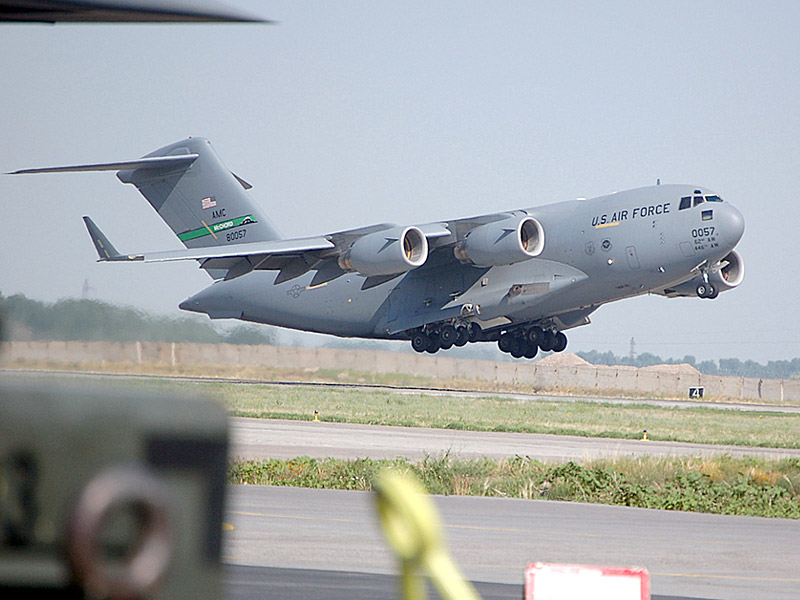
Transit Center at Manas (formerly Manas Air Base and unofficially Ganci Air Base) is a United States military installation at Manas International Airport which was built 23 km north-west of Bishkek in the mid-1970s.
The transit center is American vital hub for military personnel and equipment coming and going from Afghanistan. It is also used for air refueling. The Transit Center has approximately 1,200 U.S. military and 900 Kyrgyz and Department of Defense contractor personnel performing day-to-day operations at the premier air mobility hub supporting military operations in Afghanistan.
According to the Defence Department of the United States, the transit center handles about 15 thousand passengers and 500 tonnes of cargo every month.